Disclosure: This post may contain affiliate links, meaning I get a commission if you decide to make a purchase through my links, at no extra cost to you. As an Amazon Associate, I earn from qualifying purchases.
Have you ever started a pizza night only to realize you don’t have enough dough? Or maybe you ended up with too much and had to throw it away? Learning how to calculate pizza dough is a game-changer that ensures you have just what you need—no more, no less.
In this guide, you’ll learn the simple, two-step method to scale any pizza dough recipe so you can bake for two, four, or even ten people.
How to Calculate Pizza Dough: Step 1 – The Total Dough Formula
The first step in learning how to calculate pizza dough is to figure out the total amount of dough you need. The math is simple: just multiply the number of pizzas you want by your desired dough ball weight.
Most home bakers find that a dough ball of 250g-280g is perfect for a 10-12 inch pizza.
Example:
- You want 4 pizzas
- Each dough ball = 280g
- Total dough needed = 4 pizzas × 280g = 1,120g (1.12 kg)
Calculating Pizza Dough: Step 2 – Applying Your Recipe’s Ratios
Once you have your total dough weight, you can use your recipe’s percentages to calculate the exact amount of each ingredient.
Let’s use our example of 1,120g of total dough with a standard recipe of 70% hydration and 2.5% salt.
- Flour: Total dough ÷ (1 + Hydration percentage)
- Flour = 1,120g ÷ 1.7 ≈ 659g
- Water: 70% of flour
- Water = 659g × 0.70 ≈ 461g
- Salt:2.5% of flour
- Salt = 659g × 0.025 ≈ 16.5g
- Yeast:
- The amount of yeast needed is highly dependent on the type of yeast you use (dry vs. fresh) and your proofing time (cold fermentation vs. same-day).
- For a long, cold fermentation (24-48 hours), you’ll need a very small amount, typically around 0.1-0.3% of the flour weight.
- For a same-day recipe (4-6 hours at room temperature), you will need more yeast, roughly 0.5-1% of the flour weight.
- If you are using fresh yeast, you will need to multiply the dry yeast amount by 3.
Quick Reference Table
Here’s a quick-reference table for common pizza counts, based on a 280g dough ball and a 70% hydration recipe. Yeast is not included here because the amount varies based on your chosen method.
| Pizzas | Total Dough (g) | Flour (g) | Water (g) | Salt (2.5%) |
|---|---|---|---|---|
| 2 | 560g | 330g | 231g | 8.25g |
| 4 | 1120g | 659g | 461g | 16.5g |
| 6 | 1680g | 988g | 692g | 24.7g |
| 8 | 2240g | 1318g | 923g | 33g |
My Tips
- Yeast is not included in the table because the amount varies so much based on your chosen method. Use the guidelines above to determine your exact quantity.
- If you use a pre-ferment like a poolish, make sure to account for its weight in your final total dough calculation.
- For the best results, use my recipes for Neapolitan Pizza Dough with Poolish or Neapolitan Pizza Dough with No Poolish
Tools That Help
- Digital Kitchen Scale: This is the most important tool for precision.
- Dough Scraper: Great for dividing your dough into perfectly sized balls.
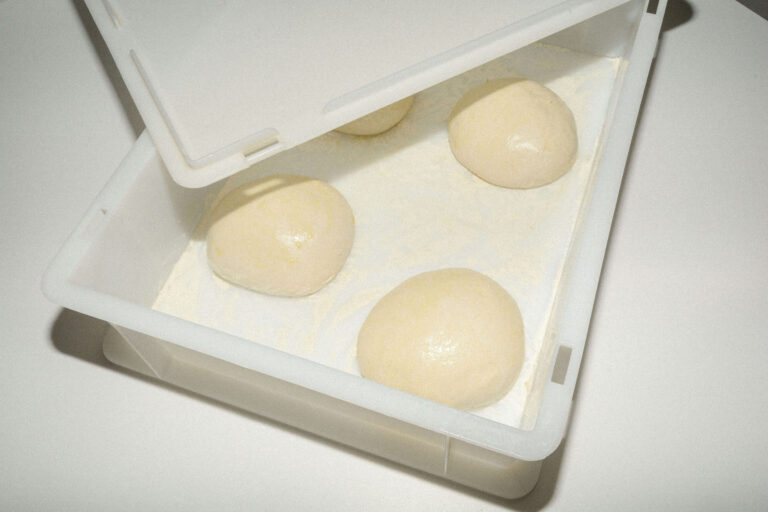
- Dough Boxes: For proofing and storing your dough.
Final Thoughts
Knowing this simple formula empowers you to calculate pizza dough quantities perfectly every time. Whether you’re baking a single pizza for yourself or hosting a big party for friends, you can scale your dough up or down with confidence.
Ready to try it? Get your free pizza tools checklist by signing up for my newsletter and never be without the right tools again!